Midori Plays Shostakovich
Tuesday, November 10, 2026 | 7:00 PM
Merrill Auditorium
Table of Contents
Program
Program At A Glance
Program Notes
Guest Artist Bios
Hear the Program
Program
Eckart Preu, Music Director
Midori, violin
Sergei Rachmaninoff The Isle of the Dead op. 29
1873-1943
Witold Lutosławski Concerto for Orchestra
1913-1994
Dmitri Shostakovich Concerto No.1 in A minor for Violin & Orchestra, op.77 (99)
1906-1975
Program at a Glance
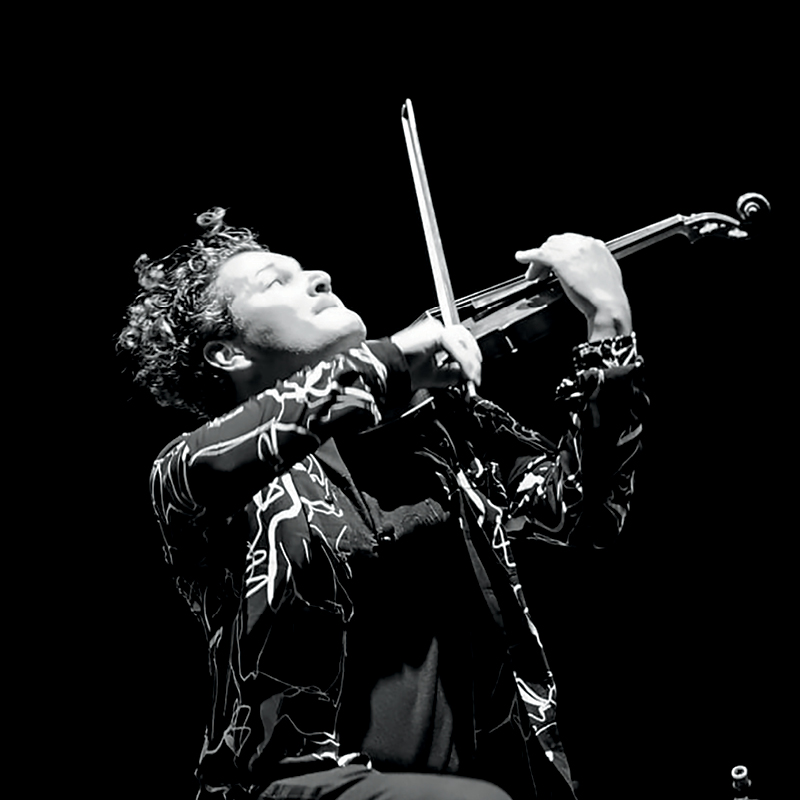
Violinist Midori makes her long-awaited Portland Symphony debut tonight in the deeply ruminative Violin Concerto No. 1 of Dmitri Shostakovich. Since her spectacular debut with the New York Philharmonic at age 11, she has performed with the world’s great orchestras, working with celebrated conductors and renowned instrumentalists. She also works frequently with living composers young and veteran, continues to record repertoire that interests her, and works to build connections between music and human experience. She is deeply committed to humanitarian and educational goals in the US, Japan and other parts of Asia, having founded several non-profit organizations. Midori is a faculty member at the Juilliard School in New York City and at the Curtis Institute of Music in Philadelphia.
Tonight’s concert also marks the first PSO performance of Sergei Rachmaninoff’s youthful tone poem, The Isle of the Dead, premiered in Moscow under the composer’s direction in 1909. This masterpiece marks the opening of an exploration of Rachmaninoff’s music over the next two PSO seasons. His popular Piano Concerto No. 2 will center the PSO’s concert on March 16, 2027, and his brilliant, unabashedly tuneful Symphony No. 2 will conclude the April 25 concert.
Returning to the program at hand, you have a rare chance to hear Witold Lutosławski’s extraordinary Concerto for Orchestra. Lutosławski remains one of the best known and most revered of twentieth century Polish composers, having worked successfully under Stalin’s artistic restrictions, and after the dictator’s death. As Mark Rohr writes elsewhere in this program, Lutosławski’s concerto pays homage to Bartók’s great work of the same title, while remaining entirely original. It is a thrilling work to perform and listen to.
Dmitri Shostakovich, like Lutosławski, chafed against Stalin’s rules, while at the same time fearing for his personal and artistic life and walking a fine line between defiance and conformity.Suspecting that his first violin concerto would be banned, or worse, he withheld its premiere until after Stalin’s death; it was first heard eight years after its completion. It now occupies an important place in the solo repertoire of adventurous violinists everywhere.
– Martin Webster
Program Notes
Sergei Rachmaninoff
The Isle of the Dead, Opus 29 (1909)
Rachmaninoff was born April 1, 1873 in Staraya Russa, Russia and died March 28, 1943 in Beverly Hills, CA. The Isle of the Dead was first performed in Moscow on April 18, 1909 with the composer conducting. The work lasts approximately 22 minutes in performance. It is scored for 3 flutes (3rddoubling piccolo), 2 oboes, English Horn, 2 clarinets, bass clarinet, 2 bassoons, contrabassoon, 6 horns, 3 trumpets, 3 trombones, tuba, timpani, percussion, harp and strings (first and second violins, violas, cellos, and basses.
*****
Sergei Rachmaninoff took inspiration for his tone poem “The Isle of the Dead” from a painting by the Swiss symbolist artist Arnold Bőcklin. The composer saw a black and white reproduction of the painting while he was in Paris in 1907 performing his second piano concerto during the “Saison russe” of Russian impresario Sergei Diaghilev. (Michelle Cann will perform Rachmaninoff’s beloved Piano Concerto No. 2 with the PSO next March 16. And on May 18, the orchestra will perform a stunning program of masterpieces inspired by Diaghilev, one of the true movers and shakers of early 20th century European culture!)
Bőcklin’s painting was immensely popular throughout Europe in the early years of the 20th century, with printed copies so ubiquitous that it was claimed that every civilized home had a print of it on the parlor wall. Bocklin wrote that it is “a dream picture: it must produce such a stillness that one would be awed by a knock on the door.”
The painter eventually painted six copies of it to meet demand from collectors. Figures as diverse as Sigmund Freud and Vladimir Lenin owned copies. At least ten composers besides Rachmaninoff wrote music in its thrall, notably Gustav Mahler and Max Reger. The San Francisco Ballet staged a choreographic version, using Rachmaninoff’s music, in 2019.
Rachmaninoff uses a large orchestra, and the music is exceedingly colorful and rich in atmosphere. It is hard to believe that he took his sole inspiration from a black and white reproduction of the painting. In fact, after he had completed the piece and led its premiere, he finally saw the full color version of the painting and was disappointed, writing that he probably would not have written his work if he had seen the color version first. All versions show a small, desolate, rocky island across an expanse of dark water. There is a rowboat steered by a figure dressed in white. The boat contains a coffin.
The composer uses a time signature of 5/8, depicting brilliantly the lapping of the waves and the dipping of the oars with uneven groups of three and two notes. As the boat nears the shore, musical fragments appear and vanish, like glimpses of the island through the mist. The piece builds inexorably to a pair of crushing climaxes before gradually subsiding into quiet. The Dies Irae, a Gregorian chant used in the mass of the dead and beloved by Rachmaninoff, appears for one of the first times in this work. It continued to inspire him throughout his life, with prominent use in many works including his final masterpiece, the Symphonic Dances for orchestra.
Commentator John Henken of the Los Angeles Times writes: “Rachmaninoff finds an amazing range of warm and glinting color within an essentially somber palette, and extends and intensifies his organically growing lines with fluent contrapuntal combinations.”
– Mark Rohr
Witold Lutosławski
Concerto for Orchestra (1954)
Witold Lutosławski was born in Warsaw, Poland in 1913 and died there in 1994. He composed this work in 1950-1954 on a commission from conductor Witold Rowicki and his newly-created Warsaw National Philharmonic Orchestra, who gave the first performance in 1954. The score calls for 3 flutes, piccolo, 3 oboes, English horn, 3 clarinets, bass clarinet, 3 bassoons, contrabassoon, 4 horns, 4 trumpets, 4 trombones, tuba, timpani, percussion, harp, celeste, piano, and strings.
*****
Since 1943, music lovers have associated the words “Concerto for Orchestra” with Bartók. Bartók was not the first to compose such a piece, but his work is one of the greatest masterpieces of the last century, and an inspiration to composers all over the world. Lutosławski’s Concerto for Orchestra not only pays homage to Bartók, it draws another composer into the picture, just as Bartók had before him.
Witold Lutosławski was born in Warsaw, Poland in 1913. He took piano and violin lessons as a child, and eventually received degrees in piano and composition from the Warsaw Conservatory. During the Nazi occupation of World War II, he supported himself by working at odd jobs and playing the piano, while composing chamber music and beginning his First Symphony. That work was banned by the Communist government in 1948, and Lutosławskifound himself in the dilemma faced by all Eastern bloc composers: how to be creative without running afoul of State censors. His solution was to base his works on folk music and to limit himself to approved techniques. After Stalin’s death artistic restrictions eased, and Lutosławskiwas able to pursue previously forbidden methods, yet the kind of artistic freedom that we take for granted was still decades away. Lutosławski later renounced his “folklorist” works, while admitting that his Concerto for Orchestra—the last of that period—was probably the best of them.
Lutosławski’s Concerto for Orchestra honors Bartók’s work without attempting to imitate it. The first movement is in several sections, in Bartók’s favorite arch form (simply, A-B-C-B-A). The first and last sections use imitative music over a sustained pedal-point, while the inner sections give a variety of colors and moods.
Lutosławski’s second movement, marked Capriccio notturno e arioso, corresponds to the nachtmusik of Bartók’s Concerto. Yet, while Bartók’s “night music” is calm and serene, Lutosławski’s is a hotbed of unseen activity. It ends with a unique duet in the drums.
In the third movement the Passacaglia theme is first heard in fragments in the basses. These coalesce into the theme that is heard in every bar of the section. When the Passacagliadies away, the bustling Toccata begins. Sharp-eared listeners will hear the motive D-E-flat-C-B, the very same motive used by Shostakovich throughout his later works, especially in the Tenth Symphony. (The motive is a musical transliteration of Shostakovich’s initials as expressed in German: DSCH.) Why Shostakovich? Again, we come back to Bartók. While Bartók was composing his Concerto for Orchestra he heard a radio broadcast of Shostakovich’s Seventh Symphony. He found the symphony’s repetitive theme unbearably banal, and he wrote a parody of it in his Concerto’s Intermezzo interrotto, replete with musical guffaws and sniggers. Now Lutosławski quotes Shostakovich as well, but with much more sympathy: Lutosławski was living with the same sorts of artistic restrictions as Shostakovich, restrictions Bartók never had to face. The Chorale follows, strongly reminiscent of the beautiful brass chorale in Bartók’s “Game of Pairs.” A brilliant presto caps the work.
After the political thaw, Lutosławski gladly took his music in new directions. It is understandable that he would reject the works he composed under the harshest artistic repression, but audiences find no reason to pass over his Concerto for Orchestra. It is a masterful piece, grateful in its homage to Bartók and knowingly sympathetic in its allusions to Shostakovich.
– Mark Rohr
Dmitri Shostakovich
Concerto for Violin & Orchestra No. 1 in A minor, Op. 77
Dmitri Shostakovich was born in Saint Petersburg, Russia in 1906 and died in Moscow in 1975. He composed this work in 1947-1948 and assigned it opus number 77; however, its premiere did not occur until 1955, in Leningrad, with David Oistrakh, violin, and Yevgeny Mravinsky leading the Leningrad Philharmonic. At the time it received the opus number 99, but Shostakovich wished it to be known as Opus 77. The concerto is scored for solo violin, 3 flutes, piccolo, 3 oboes, English horn, 3 clarinets, bass clarinet, 3 bassoons, contrabassoon, 4 horns, tuba, timpani, percussion, 2 harps, celeste, and strings.
*****
Shostakovich completed this concerto in 1948, but it was not performed publicly until 1955. Joseph Stalin died in 1953. This sequence of events is not a coincidence. In 1948, as he was composing the Passacaglia of this concerto, Shostakovich and his music were denounced by Soviet authorities, along with Prokofiev, Khachaturian, Myakovsky, and others; all were required to renounce their own music in public and apologize for their transgressions. The charge against them was “formalism”—a term so elastic as to mean, essentially, anything the authorities didn’t like. Fearful that the charge would be laid against his concerto—and anyone involved in performing it—Shostakovich put it on the shelf for seven years.
He called the first movement a Nocturne; the title is apt, for the music lives primarily at the softer end of the dynamic scale. Yet it is a harrowing night: one senses deep tragedy in the dark harmonies and the long, almost-continuous lyric line of the violin. At times the volume rises with passionate intensity and then ebbs back into the shadows, desolate and unresolved.
The Scherzo that follows is one of those works that one instantly recognizes as Shostakovich: sardonic is simply too mild a word for it. At times we seem to be hearing a thoroughly mad peasant dance, at others a strutting, almost goose-stepping military march. Sanity seems a quaint and distant notion.
This Scherzo is the first time Shostakovich “composed himself” into the music just as Bach had done centuries before. The letters in Bach’s last name, in the German musical vernacular, translate into the notes B-flat, A, C, B-natural. By using the German transliteration of his name—“Schostakowitsch”—Shostakovich transforms the letters DSCH into the notes D, E-flat, C, B-natural. This motto may be transposed to any pitch—it’s the sequence of intervals that matters. In the Scherzo the motto is sometimes blatant and sometimes buried in the accompaniment, but if you listen closely you will find it almost everywhere. Shostakovich used this personal motto several times more in his later works, most notably in the Tenth and Fifteenth Symphonies and the Eighth String Quartet; to what end, no one really knows.
Shostakovich called the next movement Passacaglia, a form popular in the Baroque that fell into disuse in the 18th and 19th centuries only to be revived in the 20th. A passacaglia is usually a set of variations played over a bass line that repeats throughout the piece. (Rules of composition are meant to be broken, of course, so there are passacaglias whose bass melody ascends into upper voices or even disappears altogether.) We hear Shostakovich’s seventeen-bar bass line straight away in the basses and cellos, with the horns hammering a bleak fanfare above. Eight more variations follow. In the last, the violin plays the horn fanfare that opened the movement and the accompaniment fades away; we have reached the cadenza.
In most concertos the cadenza is the frosting on the cake: a place where the music stops and the soloist applies his virtuosic decorations. But in this concerto the cadenza is the musical and emotional core of the work, an extraordinary exploration of the themes heard in the previous movements.
The cadenza leads straight into the Burlesque finale. While this is not exactly lightweight music, the bounds of gravity are loosed somehow, and we are taken for a wild ride by a composer whose favorite diversion was a roller coaster.
– Mark Rohr
Mark Rohr was the Portland Symphony Orchestra’s Bass Trombonist from the mid-1980’s and program annotator from 1991 until his passing in 2019. We are privileged to continue publishing his program notes at his bequest.
Guest Artist Bios
Eckart Preu, Music Director
Midori, violin
Midori is a visionary artist, activist and educator who explores and builds connections between music and the human experience. In the four decades since her debut with the New York Philharmonic at age 11, she has performed with many of the world’s most prestigious orchestras and has collaborated with world-renowned musicians including Isaac Stern, Leonard Bernstein, Yo-Yo Ma, and many others.
In the 2026-27 season, Midori debuts a new work by Thierry Escaich on U.S. recital tours in February (Baltimore, Philadelphia and New York) and April (Palm Springs, CA and Troy, NY). She performs Tchaikovsky and Mendelssohn on an eight-city coast-to-coast U.S. tour with Festival Strings Lucerne in February, and the Shostakovich Violin Concerto No. 1 with both the Grand Rapids Symphony Orchestra and the Portland (Maine) Symphony Orchestra.
In addition to her U.S. appearances, Midori’s European engagements include the world premiere of a new concerto for two violins by Detlev Glanert with the Gewandhaus Orchestra, with Semyon Bychkov, conductor, and Renaud Capuçon, violin; performances of the Mendelssohn Violin Concerto in Holland and Belgium with the Bamberg Symphony under Manfred Honeck; a recital at Wigmore Hall; and the world premiere of the Escaich work at the Schleswig-Holstein Festival in August. She also appears with the Orchestre de Paris and tours with Kremerata Baltica, performing a new two-violin work with violinist Gidon Kremer in honor of his 80th birthday, written for them by three Baltic composers. In Asia, she performs in a theatrical multimedia project in January as part of Suntory Hall’s 40th Anniversary.
Her latest album, Schumann: Violin Concerto & Works for Violin and Piano by Clara and Robert Schumann, with Festival Strings Lucerne and Özgür Aydin, was released on Pentatone in March 2026. In August, Orchid Classics releases a digital EP with the world premiere recording of Derek Bermel’s Spring Cadenzas, written for Midori’s Orchestra Residencies Program.
Deeply committed to furthering humanitarian and educational goals, Midori has founded several non-profit organizations. The New York City-based Midori & Friends, active for over three decades, offers accessible, tuition-free music education programs to students in NYC. Based in Japan, MUSIC SHARING brings both Western classical and traditional Japanese music to young people throughout Japan and developing areas of Asia; the organization’s International Community Engagement Program (ICEP) program traveled to Cambodia and Japan last season. The Orchestra Residencies Program (ORP) supports youth orchestras around the country. Midori’s Partners in Performance (PiP) helps to bring chamber music to smaller communities in the U.S. In recognition of her work as an artist and humanitarian, she serves as a United Nations Messenger of Peace, and was named a Kennedy Center Honoree in 2021.
Born in Osaka in 1971, she began her violin studies with her mother, Setsu Goto, at an early age. In 1982, conductor Zubin Mehta invited the then 11-year-old Midori to perform with the New York Philharmonic in the orchestra’s annual New Year’s Eve concert, where the foundation was laid for her subsequent career. Midori joined the faculty of the Juilliard School in 2025. She is Artistic Director of Ravinia Steans Music Institute’s Piano & Strings program. She previously served as the Jascha Heifetz Chair in Violin at USC Thornton School of Music. She is the recipient of honorary doctorates from Smith College, Yale University, Longy School of Music and Shenandoah University, and of the 2023 Brandeis Creative Arts Award from Brandeis University.
Hear the Concert